julY 26, 2016 | MEN'S BASKETBALL | ARTICLE LINK pre-season notes | 2016-17 schedule | pac-12 release UCLA will open its league slate at the Oregon schools during the final week of December. SAN FRANCISCO – The Pac-12 Conference has announced home and away designations for weekly league matchups during the 2016-17 men's basketball season.
UCLA will open its Pac-12 schedule on the road, playing four of its first six league games away from Pauley Pavilion. However, the Bruins will conclude their Pac-12 slate at home, with five of their final seven games to be played in Westwood.
The conference's schedule announcement reflects the games being played each week and the home/away designation. Specific dates of each game within a week have not yet been determined, as that information will be released after the televised selections have been made and approved later this summer.
Tip-off of the league's regular season will begin no earlier than Wednesday, Dec. 28. That week (Dec. 28-Jan. 1), the Bruins will open their Pac-12 slate on the road at Oregon and Oregon State. UCLA's first home Pac-12 games will be against Stanford and California (Jan. 4-8). The Bruins will return to the road with games at Utah and Colorado the week of Jan. 11-15.
UCLA will host the Arizona schools the week of Jan. 18-22 before playing at crosstown rival USC during the week of Jan. 25-29. The Bruins will play at the Washington schools the following week (Feb. 1-5) before returning home for five of their final seven games in Pauley Pavilion.
UCLA will host the Oregon schools during the week of Feb. 8-12 and USC the following week. The Bruins will play at the Arizona schools (Feb. 22-26) before closing the regular season at home against the Washington schools (March 1-4). Regular-season play is scheduled to conclude on Saturday, March 4.
The Bruins' regular season opens at home versus Pacific on Friday, Nov. 11. UCLA will host an exhibition game against Master's College on Friday, Nov. 1. Season ticket packages and single-game tickets for home non-conference games are on sale. For more information, visit uclabruins.com/basketballtickets or call the Central Ticket Office at (310) UCLA-WIN (310-825-2946).
To have the full schedule automatically sync to your personal calendar when it's announced in September, click here.
UCLA's Pac-12 Schedule – At a Glance
Week of Dec. 28-Jan. 1: at Oregon/Oregon State Week of Jan. 4-8: California/Stanford (Pauley Pavilion) Week of Jan. 11-15: at Colorado/Utah Week of Jan. 18-22: Arizona/Arizona State (Pauley Pavilion) Week of Jan. 25-29: at USC Week of Feb. 1-5: at Washington/Washington State Week of Feb. 8-12: Oregon/Oregon State (Pauley Pavilion) Week of Feb. 15-19: USC (Pauley Pavilion) Week of Feb. 22-26: at Arizona/Arizona State Week of March 1-4: Washington/Washington State (Pauley Pavilion) Related post: 2016-17 Non-Conference schedule out
LAS VEGAS – Former UCLA standout guard Norman Powell has secured second-team All-NBA Summer League honors, as announced by the league on Sunday.
Powell averaged a team-leading 19.8 points per game in five contests this month for the Toronto Raptors' NBA Summer League squad. The 6-foot-4 guard from San Diego also registered 4.4 rebounds and 2.6 assists per game, shooting 42.6 percent from the field and 46.2 percent from 3-point range. Powell made 82.9 percent of his free throw attempts.
Powell, who graduated from UCLA in June 2015 after a four-year career for the Bruins, secured first-team All-NBA Summer League acclaim last July as a rookie.
In his first full season with the Raptors (2015-16), Powell averaged 5.6 points and 2.3 rebounds per game. He played in 49 games and made 24 starts, helping Toronto advance to the 2016 Eastern Conference Finals.
All-NBA Summer League first-team selections this year included Jordan McRae (Cleveland), Bobby Portis (Chicago), Ben Simmons (Philadelphia) and Alan Williams (Phoenix.). Tyus Jones (Minnesota) was named the league's Most Valuable Player.
In addition to Powell, the league's second-team selections included Jaylen Brown (Boston), Thon Maker (Milwaukee), Kelly Oubre Jr. (Washington) and Tyler Ulis (Phoenix).
June 27, 2016 | UCLA Basketball Website | Article Link
The UCLA Athletic Hall of Fame Class of 2016 will be inducted on Sept. 30, 2016.
UCLA Athletics will induct eight new members into its Hall of Fame on Sept. 30, 2016, honoring a distinguished class made up of All-Americans, NCAA champions, Olympic medalists and professional All-Stars. The group will be honored at halftime of the UCLA-Arizona football game on Oct. 1.
The members of the Class of 2016 are: Julie Adams (softball), Jamie Dantzscher (women's gymnastics), Baron Davis(men's basketball), Natalie Golda (women's water polo), Chris Henderson (men's soccer), Adam Krikorian (water polo),Mike Marsh (track & field) and Wendell Tyler (football).
The group includes six NCAA champions (Adams, Dantzscher, Golda, Henderson, Krikorian and Marsh) who have totaled 26 national team and individual championships between them, three Olympians who have combined to win six Olympic medals (Dantzscher, Golda, Marsh), a Women's College World Series Most Outstanding Player (Adams), an NBA All-Star (Davis), and a Super Bowl champion (Tyler).
Following are biographies on the 2016 UCLA Athletic Hall of Fame inductees:
Julie Adams (Softball, 1996-2000)
Few things exemplified the heart of a champion more than Julie Adams' performance at the 1999 Women's College World Series, where she was named the Most Outstanding Player despite dislocating her left shoulder in the Bruins' opening game. Adams gutted through the injury and hit .667 in the tournament, driving in two RBI in the 3-2 championship game victory over Washington. She was a two-time All-American, four-time All-Pac-10 selection and the Pac-10 Newcomer of the Year in 1996. Adams finished her career hitting .353 with 40 home runs, 166 RBI, 31 doubles, 116 runs scored and 95 walks and ranked in the Top 10 all-time in RBI, walks and home runs. A three-year U.S. National Team member and a National Pro Fastpitch player in 2000, Adams went on to earn a Masters in Athletic Administration and is currently an assistant principal at Bellflower High School.
Jamie Dantzscher (Gymnastics, 2001-04)
Olympic bronze medalist Jamie Dantzscher cemented herself in Bruin lore the very first time she chalked up for a routine, scoring a perfect 10 on uneven bars right out of the gate in her collegiate debut. She is believed to be the first NCAA gymnast ever to score a perfect 10 on her first routine, and she went on to earn a school-record 28 10.0s in her career, including a national record seven in a row on floor exercise in 2002. Dantzscher led UCLA to three NCAA team titles (2001, 2003 and 2004) and won four NCAA individual titles of her own, including the 2002 all-around, vault and floor exercise crowns, and the 2003 uneven bars title. She also won the Pac-10 bars and floor titles in 2002 and the floor title in 2001 and was the 2002 Pac-10 Gymnast of the Year and a three-time Pac-10 All-Academic honoree. The 15-time All-American and 2004 AAI Award winner was named to the Pac-12 All-Century Team in the all-around and floor exercise.
Baron Davis (Men's Basketball, 1998-99)
As the No. 1 recruit in the nation at the point guard position, Baron Davis came to UCLA with much fanfare and did not disappoint. As a freshman, he played 32 games and started in 31, averaging 11.7 points and leading the team with 161 assists and 77 steals. His season was cut short due to a torn ACL during the NCAA Tournament's second round, and the Bruins lost in the Sweet 16 without him. Davis rebounded from his injury with an outstanding sophomore season, leading the Bruins in scoring with a 15.9 points per game average and earning first-team All-Pac-10 and Team MVP honors. Davis turned pro after his sophomore year and was rewarded as the No. 3 overall pick in the NBA draft by the Charlotte Hornets. He averaged 16.1 points, 7.2 assists and 3.8 rebounds during his 13-year NBA career and was a two-time All-Star. In 2004 he was an All-NBA selection and the winner of the Skills Competition at the All-Star Game. Davis has also had success in the entertainment field as an actor and producer.
Natalie (Golda) Benson (Women's Water Polo, 2001-05)
Considered one of the greatest women's water polo players of all-time, two-time Olympic medalist Natalie Golda led UCLA to three NCAA titles in her four years at UCLA (2001, 2003 and 2005). Golda was a three-time All-American and NCAA All-Tournament Team selection and was dominant in her senior season in 2005, winning the Cutino Award as the best collegiate player in the nation after leading UCLA to a 33-0 season. She won MVP honors at the 2005 NCAA Tournament after scoring four goals in three tournament games. Golda finished the year with 47 goals and recorded the third-most career goals in UCLA history with 158. On the national team level, she started in two Olympic Games, winning bronze in 2004 and silver in 2008. She also led the U.S. to three FINA World Championship medals, including gold in 2003 and 2007. Golda, who was just hired to lead the newly-formed Fresno State women's water polo team, was elected into the USA Water Polo Hall of Fame in 2015 and recently named to the Pac-12 All-Century Team.
Chris Henderson (Men's Soccer, 1989-90)
U.S. National Team standout Chris Henderson is the eighth men's soccer player to earn induction into the UCLA Athletics Hall of Fame. Henderson was selected to Soccer America's All-Freshman team in 1989, and as a sophomore in 1990, he earned first-team NSCAA All-America honors while leading the Bruins to their second NCAA title. He was one of just three collegiate players to earn a spot on the 1990 U.S. World Cup team and was the youngest player in the tournament. Henderson, who totaled 79 caps for the U.S. National Team, was also a member of the 1992 U.S. Olympic team and an alternate for the 1994 and 1998 World Cup squads. After playing professionally in Europe, Henderson played in Major League Soccer from 1996-2001 and retired as the league's all-time leader in games played with 317. He still shares the MLS single-game assist record with four, and his 80 regular-season assists rank No. 10 all-time. The two-time MLS All-Star won the 2000 MLS Cup with the Kansas City Wizards and was named the MLS W.O.R.K.S. Humanitarian of the Year in 2004. He has been the Sporting Director for the Seattle Sounders FC since 2008 and helped guide the club to four Lamar Hunt U.S. Open Cup titles, including three consecutive from 2009-11.
Adam Krikorian, Water Polo (1992-95, Student-Athlete; 1999-2009, Coach)
With a total of 15 national championships as a player, assistant coach and head coach, Adam Krikorian is one of the most successful Bruins in history. As a student-athlete, he earned All-America honors as a senior and helped lead the Bruins to the 1995 NCAA Championship, scoring two goals in the title game. As an assistant coach, he helped guide the men's team to a repeat championship in 1996 and the women's team to back-to-back titles in 1997 and 1998. He became co-head coach of both programs in 1999 and went on to win three more NCAA titles with the men (1999, 2000, 2004) and eight national titles with the women (2000, 2001, 2003, and a five-peat from 2005-09). Krikorian became head coach of the U.S. Women's National Team following the 2009 season, and he has been near perfect, leading Team USA to gold medals in nine of 12 major FINA Championships, including Olympic gold in 2012. Krikorian was recently named the Pac-12's Women's Water Polo Coach of the Century and was honored in 2013 as the USOC National Coach of the Year.
Mike Marsh, Track & Field (1986-89)
Sprinter Mike Marsh won three Olympic medals, including two gold, as well as two NCAA team titles, three Pac-10 team titles and five Pac-10 individual titles. Marsh still holds some of the best marks in UCLA history, with his 10.07 time in the 100m ranking second and his 20.35 time in the 200m ranking sixth. He was also a member of the 4x100m relay team that set a school record in 1988 with a time of 38.59. He won the Pac-10 100m titles in 1986 and 1988, placed third in the 100m and 4x100m relay at the 1987 NCAA Championships and was fourth in the 100m and second in the 4x100m relay at the 1988 NCAA Championships. Marsh ranked in the Top 10 in the U.S. in the 100m for 11 years in a row (1987-97) and in the 200m for six years in a row (1991-96) and won U.S. titles in the 200m in 1993 and in the 100m in 1995. He set an Olympic record in the 200m to win gold at the 1992 Olympics and ran a leg on the gold-medal winning 4x100m relay team that set a world record. He captured silver in the 4x100m relay at the 1996 Olympics and was fifth in the 100m and eighth in the 200m.
Wendell Tyler, Football (1973-76)
One of the heroes of UCLA's legendary 1976 Rose Bowl victory over top-ranked Ohio State, Wendell Tyler finished his UCLA career as the school's all-time leading rusher with 3,181 yards, and his career average of 6.04 yards per carry still ranks second all-time. He also set school records for single-season rushing yards (1,388) and yards-per-carry (6.7 average) in 1975. Tyler rushed for more than 100 yards on 12 occasions during his career, most notably in the 1976 Rose Bowl game, when he totaled 172 yards, including a 54-yard touchdown run to seal the Bruin victory. Following his UCLA career, Tyler went on to play in the NFL for 10 seasons with the Los Angeles Rams and San Francisco 49ers and helped the 49ers win the 1986 Super Bowl. He finished his pro career with over 6,300 yards rushing, over 1,800 yards receiving and a total of 66 touchdowns.
Commits: 3 Spots Left: 1 Open Offers: 17 ESPN Top 60 players for 2017 (List link) Verbal Commits Jaylen Hands PG (San Diego/Foothills Christian HS) ESPN 2017 #38 player
LiAngelo Ball SG (Chino Hills/Chino Hills HS)
Jalen Hill C (Corona, CA/Centennial HS) ESPN 2017 #44 player
Offered 1) Point Guards Treven Duval (Wilmington, DE/Advanced Prep Intl) ESPN 2017 #5 player
Troy Brown Jr. (Las Vegas, NV/Centennial HS) ESPN 2017 #28 player
Trae Young (Norman, OK/Norman North HS) ESPN 2017 #21 player
2) Shooting Guards Gary Trent Jr. (Apple Valley, MN/Apple Valley HS) ESPN 2017 #9 player
Lonnie Walker (Reading, PA/Reading HS) ESPN 2017 #14 player
Charles "Chuck" O'Bannon Jr. (Las Vegas, NV/Bishop Gorman HS) ESPN 2017 #23 player
Jaylen Nowell (Seattle, WA/Garfield HS) ESPN 2017 #45 player
3) Small Forwards Kris Wilkes (Indianapolis, IN/North Central HS) ESPN 2017 #11 player
Brian "Tugs" Bowen (Saginaw, MI/La Muiere) ESPN 2017 #10 player
D.J. Harvey Jr. (Bowie, MD/DeMatha Catholic HS) ESPN 2017 #36 player
Andre Rafus (Roselle, NJ/Roselle Catholic HS) 4) Power Forwards Cody Riley (Chatsworth, CA/Sierra Canyon HS) ESPN 2017 #40 player
Ira Lee (Chatsworth, CA/Prolific) ESPN 2017 #77 player
5) Centers Nicholas Richards (Queens, NY/The Patrick School) ESPN 2017 #8 player
Jeremiah Tilmon (East St. Louis, IL/La Lumiere School) ESPN 2017 #29 player
Malik Williams (Ft. Wayne, IN/R. NelsonSnider HS) ESPN 2017 #42 player
Isiah Jasey (Killeen, TX/Sunrise Christian Academy) (Monster block on Vine link)
Commits: 0 Spots Left: 3 Open Offers: 13 All offerees are included in the ESPN Top 60 players for 2018 (List link) 1) Point Guards Darius Garland (Brentwood, TN/Brentwood Academy) ESPN 2018 #17 player
Immanuel Quickley (Bel Air, MD/John Carroll School) ESPN 2018 #19 player Brandon Williams (Encino, CA/Crespi Carmelite HS) ESPN 2018 #31 player 2) Shooting Guards Romeo Langford (New Albany, IN/New Albany Sr HS) ESPN 2018 #2 player
Jules Bernard (Los Angeles/Windward) ESPN 2018 #53 player 3) Small Forwards Gerald Liddell (Cibolo, TX/Byron P. Steele II HS) ESPN 2018 #8 player
Zion Williamson (Spartanburg, SC/Spartanburg Day School)ESPN 2018 #10 player
Jaedon LeDee (Houston, TX/Kincaid School) ESPN 2018 #34 player
Timmy Allen (Mesa, AZ/Desert Ridge HS) ESPN 2018 #60 player
4) Power Forwards Marvin Bagley III (Phoenix, AZ/Sierra Canyon) ESPN 2018 #1 player
Jordan Brown (Roseville, CA/Woodcreek) ESPN 2018 #3 player
E.J. Montgomery (Fort Pierce, FL/Montverde Academy) ESPN 2018 #13 player
Shareef O'Neal (Los Angeles/Windward HS) ESPN 2018 #51 player
This documentary follows the former NBA All-Star Baron Davis and his transition from living in the harsh neighborhood of South Central to attending the predominately upper-class private school, Crossroads. There he left a basketball legacy that will forever be remembered.
Credits: Directed, Edited and Produced by Micah Stein, Ben Recht and Paxton Fuller
Somuch has to go wrong for a Steph Curry 3-pointer to be deemed a bad shot.
If he’s pulling up from 30 feet, in transition, but there isn’t a defender reactive enough to get a hand up, it’s not a bad shot. If Curry circles around a defense and launches an off-kilter 3 at the first sign of daylight, but draws the eyes of four opponents in the process, it’s not a bad shot. If it breaks all the unwritten laws of respectability on a basketball court — but it goes in? Not a bad shot.
Great players are expected to evolve. In 2010, Kevin Durant developed a career-altering crossover; in 2012, LeBron James became a master of efficiency with an improved post game. But the NBA was not prepared for what Curry added to his arsenal this season.
He shot 16 3-pointers from 30-plus feet during the 2014–15 regular season; he nearly tripled his total on such attempts in 2015–16. As the world attempted to catch the Golden State Warriors’ comet by the tail, Curry’s expect-the-unexpected theatrics forced observers to create a new scale for grading his unprecedented shot selection.
Four hundred miles south of Oracle Arena sits the gym inside Chino Hills High School, the only place in the nation where more conventionally bad shots have been attempted this year. Chino Hills is the home of the Ball family — three brothers and their basketball-minded parents — who are intent on stretching the fabric of basketball as we know it, one 35-footer at a time. LaVar is the patriarch, and the mind behind the madness.
“My thing is, a bad shot is a shot you don’t practice,” LaVar Ball told me. “If you practice shooting from 30, 40 feet, that [can be] a good shot. It’s better to shoot a 30-footer with nobody in your face and go through your technique and your form, as opposed to shooting right on the 3-point line with a hand in your face.”
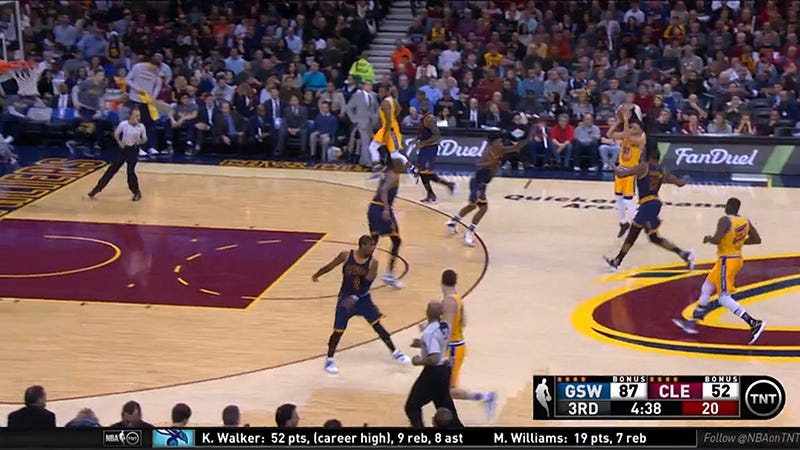
On Martin Luther King Jr. Day, during the second regular-season meeting between the Golden State Warriors and the Cleveland Cavaliers, Curry actually did take a bad shot. It happened with less than five minutes to go in the third quarter; Curry strolled into the frontcourt with the ball in his hands and casually pulled up from right above where the Cavaliers’ enormous “C” logo at center court begins to curve. The ball barely grazed the front of the rim before it landed in the hands of Kyrie Irving. At that point, the Warriors were up 87–52. Curry was bored, so he chucked one just to do it.
During the first regular-season clash between the Warriors and Cavs, back on Christmas Day, ESPN analyst Mark Jackson uttered a statement that would come to encapsulate the fears of a bygone generation: “He’s hurting the game. … And what I mean by that is that I go into these high school gyms, I watch these kids, and the first thing they do is they run to the 3-point line. You are not Steph Curry.”
Maybe not, but what if there were a kid who was another Steph Curry? Four hours earlier on that same MLK Day, LaVar Ball’s oldest son, Chino Hills senior point guard Lonzo Ball, took a shot from nearly the same spot on the floor in Springfield, Massachusetts, the birthplace of basketball. Sometimes the present and future run parallel.
Like Curry, Ball was not beholden to the concept of acceptable range. Some may blanch at Ball’s hubris (the ESPNU announcer described this long miss as “not a good shot”). But ultimately, this is how the world spins forward.
“Modern mathematics tends to obliterate history,” Robin Hartshorne wrote in his 1977 textbook, Algebraic Geometry. “Each new school rewrites the foundations of its subject in its own language, which makes for fine logic but poor pedagogy.”
You could field quite a team made up of former players who derided the Warriors’ run at history this season: Oscar Robertson, Charles Barkley, Scottie Pippen, Gary Payton, Tracy McGrady. That older-generation disdain for the new value system in basketball is an act of self-preservation in the face of watching something once so intimately familiar grow more and more foreign.
It’s been said that a fast-breaking, 3-point-shooting team couldn’t win a championship; the Warriors quieted the critics with last year’s Finals win, but a less concrete version of the same criticism remains embedded in the national discourse. Those older players could just as easily be talking about the Ball family. LaVar Ball hears their complaints, and brushes them aside.
“This is what I tell people [when asked] why we play so fast. We don’t think the game, we just play off of reaction,” LaVar told me. “When you hear a loud sound in the hood, you don’t say, ‘Was that a broken plate, a broken window, or a gunshot?’ You don’t think about it. You just take off running. And it’s simple, but people think it’s too simple. Everybody’s always telling me, since the boys were young, ‘Oh, that’s not going to work. They’re not going to let you do that.’ Well, OK. We’re going to do it anyway, and watch what happens.”
For much of basketball’s history, the key to winning games has come down to controlling the area around the basket, on both sides of the court. The advent of and later emphasis on the 3-point shot offered another way to look at the game. We know this; we’ve seen it unfold over the past 20 years. Now, the team that best takes advantage of the full dimensions of the court wins.
We are in the middle of basketball’s space race, and the Warriors are at the vanguard of these notions. Golden State has advanced to its second consecutive NBA Finals after a Western Conference finals Game 7 in which nearly half of the team’s made field goals came from behind the arc. While their turbulent playoffs have proved that the Warriors aren’t “light-years ahead,” as majority owner Joe Lacob has boasted, they do serve as an avatar for an idea whose time has come. But they aren’t the only ones.
The Chino Hills Huskies look like the future. In 35 games, they turned high school basketball contests into imaginariums filled with 35-foot-long bombs and full-court bullet passes. They are an unholy amalgam of the System offense that Paul Westhead spearheaded with his Loyola Marymount teams of the late ’80s and the deep-space exploration of the current Warriors. They have internalized the tenets of modern countercultural basketball — make use of the entire court on both offense and defense, maximize possessions by forcing opponents to play at unsustainable speeds, shoot as many 3s as possible.
Watching the Huskies in motion can seem like peering directly into an alternate timeline, where what had long been considered verboten in the sport is simply common sense. In 35 games, Chino Hills, the nation’s consensus no. 1, went undefeated and tied the California state record for most 100-point games, with 18. The team produced one of the greatest seasons of amateur basketball ever.
High schools across the country were rocked by the Ball brothers: Lonzo Ball, an incoming UCLA freshman and ESPN’s no. 4 senior in the nation; LiAngelo Ball, incoming senior and the Huskies’ leading scorer this year; and LaMelo Ball, a 14-year-old whom the family had bumped up a grade to fulfill LaVar’s dream for all three brothers to play one year of varsity basketball on the same team.
Together, the brothers stick together like magnets. Lonzo is the stoic, exceedingly selfless caretaker: At the 2016 McDonald’s All American Game, he tied the record for most assists in a game with 13, without scoring a single point. LiAngelo is the bully who benches 350: at a reported 6-foot-6 and 215 pounds, Gelo is a defensive end posing as a shooting guard — LaVar had experimented with him at the point, but quickly yanked him after realizing that LiAngelo would shoot the ball with impunity every time he crossed half court.
LaMelo is the id and, as LaVar put it, the family’s “hybrid” guard; his blazing Odell Beckham Jr.–inspired hair and penchant for drilling 30-footers despite appearing to lack the strength to even properly finish a layup have made him the most popular brother of the three.
They all consider themselves entertainers on the court as much as basketball players, though you wouldn’t be able to tell from their faces — a pause for a celebratory yawp after a made basket is a missed steal opportunity, or a split second not spent setting up a trap. Off the court, things are looser. For one thing, it seems like LiAngelo has inherited more than just his father’s titanic frame.
Word spread quickly about the team that Chino Hills had assembled. In a tournament game last June, LaMelo made his high school debut in the starting lineup as a 13-year-old. He scored 27 points. The team scored 98. High school sports reporters looking for a good story quickly realized they could be looking at the story. “It was kind of the perfect storm that was looming for Southern California basketball,” Eric Sondheimer, a Los Angeles Times writer who has covered high school athletics for 40 years, told me. “I wrote that it was going to be like the circus when everybody starts getting on the bandwagon. And sure enough …”
When calling in favors didn’t work, opposing league coaches paid for their own tickets to watch Chino Hills play in tournaments. Sondheimer would show up to games several hours ahead of time just to ensure himself a parking spot, though that didn’t always guarantee him a seat.
For an incomplete picture of Chino Hills’ dominance, consider this: Even if you were to strike out their most lopsided victory — an 89-point win in their first league game of last season — the Huskies’ total point differential would still be greater than the Warriors’ in the NBA. Golden State outscored its opponents by 882 points during the 2015–16 regular season; Chino Hills outscored its opponents by 994 in 47 fewer games.
All this came as no surprise to LaVar Ball. “I said it a long time ago,” he said. “I told them, ‘I guarantee, when my other son gets there, there is not a team in America that can beat us.’”
In addition to being the megaphone, LaVar is also the family’s basketball architect. He was a 6-foot-6, 270-pound tight end who spent several years on the New York Jets and Carolina Panthers practice squads in the mid-’90s. He married Tina Slatinsky, his college sweetheart, who played basketball at Cal State Los Angeles. Together, they coach Big Ballers VXT, the AAU team that served as a lab for the family’s playing style.
“We play faster than the Golden State Warriors. And my boys have been playing like this since they were little.” —LaVar Ball
Steve Baik ostensibly coached Chino Hills (he left the team at the end of the season), but the coach submitted to, and later espoused completely, the style of play that had been instilled by the Ball family. No sets, just immediate read-and-reaction. “It was something ingrained in them since when they were young,” Baik told The New York Times. “They’re just so good at doing it, we’ve just embraced it.”
On defense, the Huskies play a zone press scheme, physically hounding their opponents into traps. They gang rebound with their best athletes as LaMelo leaks out into the frontcourt. That’s how the magic starts. The secret to Chino Hills’ success last season was that there was no secret. On the court, Lonzo controls everything in his orbit. His signature move might be one of the most breathtaking plays in all of basketball: the one-handed full-court outlet pass.
The pass is an act of familial telepathy. Lonzo usually catches one of his brothers in stride for a layup, but on at least one occasion that I witnessed, he threw a full-length, crosscourt pass from the right side of the court all the way to LaMelo in the left corner on the opposite end. It’s a modern wonder: He throws the ball while he’s turning over his shoulder in midair, before he has a sight line to his brother’s exact location. It’s muscle memory (Lonzo’s been throwing outlets since he was a third-grader playing against eighth-grade teams) and muscles, period (despite being a wiry 6-foot-6 guard at 195 pounds, Lonzo bench-presses 270 pounds). The outlet is a cornerstone of the Ball brothers’ high-octane offense. “All you’re trying to do is get a good shot,” LaVar said. “I can’t help it if we get it in the first two or three seconds. Because you’re going to pass the ball around six or seven times and get the same shot we got in the corner off the first pass.”
The Ball brothers are encouraged to fire away from deep, even after misses. They use conventional basketball wisdom as a weapon against their opponents. “Everyone usually plays defense right at the 3-point line, because that’s what you’re taught,” LaVar said. “But we use more of the court.” By forcing defenses to acknowledge the potency of every inch of the floor, you take control of your opponent. It’s easier to capitulate to a team like Chino Hills than it is to unlearn years of foundational knowledge. It’s how the Warriors confounded the league all season — the NBA had to learn how to prevent shots that, before, never had to be guarded in the first place.
For all their similarities, LaVar scoffs at the suggestion of a Warriors influence on his kids. “We play faster than the Golden State Warriors,” he said. “And my boys have been playing like this since they were little.”
But what about those 40-footers?
“I got [LaMelo] taking those since he was 7 years old,” LaVar said. “I got all my boys shooting from damn near half court.”
It’s a fair question, though. Curry’s superstar ascension is inextricable from the impossible plays he conjures, despite his suboptimal frame. With the advent of League Pass and the rise of the social media highlight, we don’t have to wait years to see the influence of a player on the next generation of athletes. We have to wait only days.
LaMelo, especially, is a dead ringer for Curry, whether he’s conscious of it or not. In a season full of dazzling plays, he never looked more like the NBA’s back-to-back MVP than he did in the third quarter of a February game against perennial California powerhouse Mater Dei.
In one sequence, Melo brought the ball up the floor and entered a truncated, Steph-like dribbling suite. He motioned left and jetted toward the paint off a high screen from Chino Hills center Onyeka Okongwu, drawing the eyes of all five Mater Dei defenders. Lonzo, stationed at the right corner, instinctively darted along the baseline past his ball-watching defender. Melo lofted the ball unconscionably high — clearing the height of the backboard — and drifted out of bounds, watching his eight-second masterpiece unfold. The ball descended on the right side of the rim, directly into the clutches of a skyward Lonzo. Okongwu — who might wind up being better than all three Ball brothers — waltzed into the lane undeterred, his hands up expecting the ball. He slowly dropped them only after he looked in front of him to realize his airborne teammate had already sealed the deal.
It would’ve been a perfectly executed 1–5 pick-and-roll by any other team, but the no. 1 team in the country didn’t reach such heights by playing conventionally. A minute later, Melo — 5-foot-10 and maybe 120 pounds — swished a straightaway 3 with his feet touching the logo at center court.
LaVar insists that LaMelo will be the best of the three, and largely credits his having to play catch-up with his older brothers to fulfill the family dream.
“[LaMelo] never played against kids his own age,” LaVar said. “That’s why it’s so easy for him in high school. He’s been playing 17U since he was 11 years old. I had him playing against eighth-graders when he was 6 and 7. It’s nothing new to him. He’s always seen people’s stomachs. He ain’t never been face-to-face with nobody.”
LaMelo, of course, is still growing. At 14, he is taller than either Lonzo or LiAngelo was at the same age. He might have a few growth spurts left in him. If he is the one to push the high school game in an exciting, unknowable direction, there’s a chance it won’t be as a Steph Curry simulacrum, but something else entirely. Three years is a long time for a teen.
AP Images
Last year, Bo Kimble, the leading scorer for the 1989–90 Loyola Marymount team that is widely regarded as the greatest offense in college basketball history, wrote a plea to college basketball: The game is facing an offensive crisis; it’s time to speed up.
In 2015, college offensive productivity had cratered, reaching a lull not seen since the 1950s. It rebounded this past season, in part thanks to a greater emphasis on the 3-pointer permeating the entire NCAA. But Kimble was advocating for something more radical than simply shooting 3s. Thirty-seven percent of the Houston Rockets’ field goal attempts this season came from behind the arc, the highest rate in the NBA; there were 132 Division I teams that matched or surpassed that figure. Not every offense built around 3-point shooting is an effective one.
Kimble played on a 1989–90 LMU team that averaged 122.4 points per 40 minutes — only a tick higher than the 122 points per 40 Chino Hills put up in its own historic season. He called for the college game to be saved. That savior might just be 18-year-old Lonzo Ball, who just so happens to be Kimble’s spiritual successor.
This fall, the Lonzo Ball experiment will begin at UCLA. A Bruins team that ranked 70th in the nation in pace and 331st in 3-point attempt rate this past season will feature an uptempo savant with limitless range — a system unto himself. Lonzo will step foot in Pauley Pavilion as the most interesting freshman in the country. There is no telling how his unorthodox basketball education will affect him in the NCAA. It’s a coach’s game at the college level. As a UCLA point guard, he’ll no longer be playing to satisfy the impulses of his father — impulses that would drive nearly any micromanaging college coach insane. Will Bruins coach Steve Alford try to fit his star recruit in a box?
“Lonzo will be used the exact same way he’s used now,” LaVar said. “That’s what’s going to shock everybody. He’s going to change the whole dynamic of the team over there. Everybody has to adjust to him. Because Alford knows I’m not giving him a player to change. He’s been watching my boys for a long time. He knows exactly what they do.”
(We attempted to contact Alford through UCLA athletic communications on Thursday, but he was not available by the time of publication.)
If LaVar sounds like he’s got a stake in the future of UCLA basketball, it’s because he’s invested a lot in the program. All three Ball brothers are committed to the Bruins, which means, for at least the next four seasons, LaVar Ball will loom as a Svengali figure in Westwood. His sons are enrolling in college, and so are his ideas. Is the NCAA ready for such an infusion of pace so soon?
“The NCAA is ready for it; it’s whether the team’s ready for it,” ESPN college basketball analyst Fran Fraschilla said in an interview. “That’s a [different] tempo that requires complete buy-in, not only from the players, but from the coach, too.”
Fraschilla runs Steph Curry’s SC30 Select Camp for the top guard recruits in the nation at the end of June in Alameda, where Lonzo has signed up as a camp counselor.
“You can’t be halfway in or halfway out in that kind of system, because it is so radically different,” Fraschilla said. “If you want to play that way, every part of your practice has to be designed to play at that pace. And it requires a lot of patience from the coach, because it is going to look ugly before it looks good.”
The university just secured what appears to be the most lucrative apparel deal in NCAA history, signing with Under Armour for $280 million over 15 years. With the infusion of sponsorship money and a new style of play, it’s hard not to see a bright future for the Bruins in the national spotlight. There will probably be some sort of moral panic the first time Lonzo takes an open 35-footer on live television — but the Balls will be fine with it, so long as you don’t chalk it up to any kind of ripple effect from up in the Bay Area.
“This ain’t no Steph Curry,” LaVar insists. “This is the Ball boys — the new breed.”